
Table of Contents
- First, separate two very different worries
- Check 1: Ask them to show you what changed on your website
- Check 2: Look at Google Search Console yourself — not their report
- Check 3: The “what would a stranger pay for” reframe
- Check 4: Match the money to the activity
- Check 5: Watch how they handle “it’s not working yet”
- The traffic-but-no-sales trap
- What “good” actually looks like
- The questions to send your agency this week
- Conclusion
This article is for business owners who are paying an SEO agency or freelancer right now and can’t tell whether the work is real. If you’ve ever stared at a monthly report full of upward-trending charts and thought “I have no idea if any of this is real,” you’re not paranoid, and you’re not alone.
Quick Answer
The right question isn’t “are they working hard?” you can’t see effort. It’s “can I verify what they did, and is it the kind of thing that actually moves a business?” Five checks below will tell you, using tools you already have access to, in under an hour.
Jump to a check:
- What changed on your site ·
- Google Search Console ·
- The stranger test ·
- Money vs. activity ·
- How they handle bad news · Traffic-but-no-sales trap ·
Questions to send this week
This piece covers what to check as a paying client with no SEO background. It does not cover how to do SEO yourself, how to hire an agency in the first place, or technical audits you’d need a specialist to run — those are separate topics.
First, separate two very different worries
People asking this question are usually feeling one of two things, and they need different answers:
Worry What it usually means Is it a red flag? “I don’t see results yet.” Rankings and traffic haven’t moved Not necessarily – see below “I can’t see any work.” No visible activity of any kind Yes – this is the real signal
Real SEO commonly takes four to twelve months to show meaningful ranking movement, longer in competitive markets — that’s the normal, unavoidable lag between publishing/optimizing a page and Google fully re-crawling, re-indexing, and re-ranking it. Slow is not the same as fake. An agency can be doing excellent work with no rankings yet (acceptable), or sending you pretty reports while doing nothing (not acceptable). The five checks below are built to tell those two apart.
Check 1: Ask them to show you what changed on your website
This is the single most powerful test, and it requires zero expertise.
Real SEO work leaves fingerprints on your actual site: new or rewritten pages, updated titles, new internal links, fixed broken pages, added schema markup.
Ask directly: “Can you show me the specific changes you made to my website in the last 30 days, with links to the exact pages?”
A working agency says A stalling agency says “Here are the 4 pages we rewrote, with before/after links” “We’ve been optimizing your site authority” “We fixed these 12 broken links – here’s the list” “We’ve been working on backlinks and technical signals” Answers in a day, with clickable specifics Gets vague, or takes a week to reply
If nothing on your website has visibly changed in three months, very little is happening – regardless of what the report says.
Check 2: Look at Google Search Console yourself, not their report
Your agency’s report is their version of reality. Google Search Console is Google’s own free tool, built for exactly this – checking how your site performs in Search, independent of what any agency tells you. If your agency hasn’t given you owner-level access, ask for it today; that gap alone is a yellow flag.
Once you’re in, look at two numbers over the last 6 months:
- Total impressions — how often you showed up in search. A rising trend means your visibility is genuinely growing, even before clicks follow.
- Average position for the queries that describe your business — slowly improving is exactly what healthy SEO looks like.
Both numbers come straight from Google – they can’t be cherry-picked or edited by your agency the way a slide in a report can.
Check 3: The "what would a stranger pay for" reframe
For any line in your report, ask: “If I described this to another business owner, would it sound like something worth money?“
- “We published 2 new pages targeting what your customers search for, and 1 is now on page 2 of Google.” → Real work.
- “We optimized 47 meta signals and improved domain trust factors.” → Words arranged to fill a slide.
You don’t need to know what a “meta signal” is. You need to notice when language is used to prevent understanding rather than create it.
Check 4: Match the money to the activity
If you’re paying, say, $2,000 a month, roughly what did that buy? A legitimate engagement has a rhythm you can feel: content created, technical issues fixed, pages improved, the occasional quality link earned, and a monthly conversation about what’s next and why. If every month produces a report but no artifacts you can point to, the math isn’t adding up — and you’re allowed to say so.
Check 5: Watch how they handle "it's not working yet"
This is the tell that exposes character. A good partner gets more transparent under pressure: here’s what we expected, here’s what happened, here’s our read on why, here’s the adjustment. A weak one disappears, turns the conversation into an upsell, or buries you in new vanity metrics to distract from the one that matters.
"The clients who get burned aren't the ones who asked too many questions — they're the ones who felt too awkward to ask any. A real SEO partner wants you asking these questions, because it's the same conversation we're already having with ourselves."
-Yana Bilousova, Founder & CEO, SparkleScale
How to Read an SEO Report (Without Knowing Any Jargon)
Most SEO reports are built to be skimmed, nodded at, and filed away. You don’t need to understand all of it, you need to find 4 numbers and ignore the rest.
The four lines that matter in any SEO report:
- Organic clicks — real people who found you in search and visited. This is the number your invoice is ultimately buying.
- Impressions trend — how often you appeared in results. Early in an engagement, this climbs before clicks do. Rising impressions with flat clicks is normal at month 3; it’s a problem at month 10.
- Average position for terms that describe what you sell — not for your own company name. Ranking #1 for your brand name isn’t SEO work; people searching your name were already looking for you.
- Which pages gained — a good report names specific pages and connects them to specific work. “Your new service page went from position 40 to 18” is verifiable. “Overall visibility improved” is not.
The lines designed to fill space:
Report says What it usually means “Keywords tracked: 500” Tracking costs nothing; ranking is what you’re paying for “Domain Authority up 2 points” A third-party estimate, not a Google metric, it can rise while your traffic falls “142 optimizations completed” Uncountable and unverifiable, ask for the list “Backlink profile strengthened” Ask to see the actual links; some can even hurt you
The test is the same one from Check 3: every line should survive being read out loud to another business owner. If a metric can’t be explained in one plain sentence, it may be there to look impressive rather than to inform you.
And if the report contradicts what you see in your own Search Console trust Search Console.
The traffic-but-no-sales trap
A specific version of this worry deserves its own answer: “They’re sending me lots of traffic, but I’m not getting any sales – is it fake?”
Sometimes the traffic itself is low-quality (bot or junk visits inflating a number). But more often it’s real and simply wrong — an agency optimizing for traffic volume will happily rank you for terms that bring browsers, not buyers.
Someone searching “how does SEO work” isn’t about to buy your product; someone searching “emergency plumber Toronto” is. If traffic is climbing but revenue is flat, ask directly: “Are we ranking for terms with buying intent, or just terms that inflate the traffic chart?”
SEO Agency Red Flags: The Patterns That Predict Wasted Money
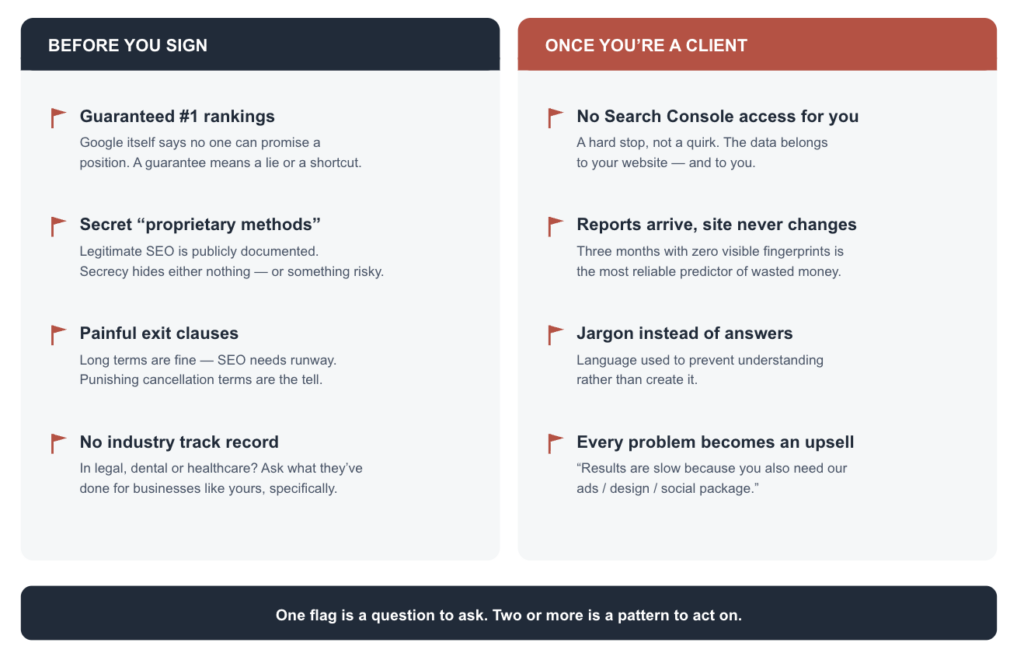
Individually, none of these proves bad faith. Two or more together, and the odds are no longer in your favor.
Red flags before you sign:
- Guaranteed rankings. Google itself says no one can guarantee a #1 position. Anyone promising one is either lying to you or planning shortcuts that can get your site penalized.
- “Proprietary methods” they can’t describe. Legitimate SEO isn’t secret — the techniques are publicly documented. Secrecy usually hides either nothing or something risky.
- Pressure to sign a long contract with a painful exit clause. Long terms are fine (SEO needs runway); punishing cancellation terms are the tell.
Red flags once you’re a client:
- They won’t give you owner-level Search Console access. As covered above — this is a hard stop, not a quirk.
- Reports arrive, but nothing on your website ever changes. Three months of invoices with zero visible fingerprints on your actual site is the single most reliable predictor of wasted money.
- Every question gets answered with jargon. Language used to prevent understanding, not create it.
- Bad months get buried instead of explained. The metric that dropped quietly vanishes from next month’s report, replaced by a new one that looks better.
- Every problem becomes an upsell. “Results are slow because you also need our paid ads / web design / social package.”
One nuance: some of the worst offenders are generalist agencies selling into specialized industries: legal, dental, healthcare where clients rarely know what industry-specific SEO should even look like. If you’re in a regulated or specialized field, the checks in this article apply doubly, and it’s fair to ask your agency what they’ve done for businesses like yours specifically.
None of this means firing your agency at the first vague sentence. It means the burden of proof sits with the party sending the invoice and a good partner never resents being asked to carry it.
How to Evaluate an SEO Agency You're Already Paying
You should be able to log into Google Search Console yourself, see visibility slowly climbing for terms your customers actually use, click through to real pages on your own site that visibly improved, and understand in plain language – what your agency did and what’s next.
If you have all of that, slow results are just SEO being SEO. If you have none of it, no report should reassure you.
Questions to Ask Your SEO Company This Week
Copy-paste these. The quality of the answers tells you most of what you need to know:
- Can you show me the specific pages on my site you changed in the last 30 days?
- Do I have owner-level access to my own Google Search Console and Analytics? If not, can you set that up today?
- Which of the keywords we’re targeting have buying intent, and how are those specifically trending?
- In plain English, what did this month’s fee pay for, and what’s the single most important thing you’re doing next?
- If results are slower than we hoped in 60 days, what’s your plan?
A confident, working agency will welcome these questions, clear expectations make their job easier too. An agency that gets defensive about being asked to show its work has just answered your original question.
*Limitations: this checklist covers what a non-technical client can verify from the outside. It doesn’t replace a full technical SEO audit, and the 4–12 month timeline is a general industry range, not a guarantee for any specific site or market.
A Few Things Worth Clearing Up First
What if my agency refuses to give me Search Console access at all?
Treat it as a hard stop, not a yellow flag. Search Console belongs to your website, not to them - refusing owner-level access (or claiming it "isn't set up that way") means you have no independent way to check their work at all, which defeats the purpose of everything above.
How long should I wait before switching agencies if nothing improves?
Give a new engagement the full 4-12 month window before judging results, but judge visible activity on a monthly basis from day one. If you're past month 6 with zero site changes and zero Search Console movement, waiting longer isn't patience, it's sunk-cost thinking.
Is a month-to-month contract safer than a long-term one?
Contract length isn't itself a signal - plenty of legitimate agencies ask for 6-12 month terms because SEO genuinely needs that runway. What matters is whether you can exit without penalty if the checks in this article keep failing. Read the cancellation clause before you sign, not after you're unhappy.
Could an agency fake the things this checklist asks for?
In theory, yes screenshots can be doctored and a list of "changes" can be invented. That's exactly why Check 2 matters most: log into Search Console yourself, in your own browser, rather than accepting any image or PDF as proof. Data you pull directly from Google's own dashboard is far harder to fabricate convincingly than a slide.
Is there a "normal" price range I can compare mine against?
It varies too much by market and scope to give a single number responsibly a solo local business and a multi-location e-commerce brand aren't buying the same service. The more useful comparison isn't the invoice total, it's the ratio in Check 4: does the monthly fee roughly match the volume of visible, verifiable work you're getting back?