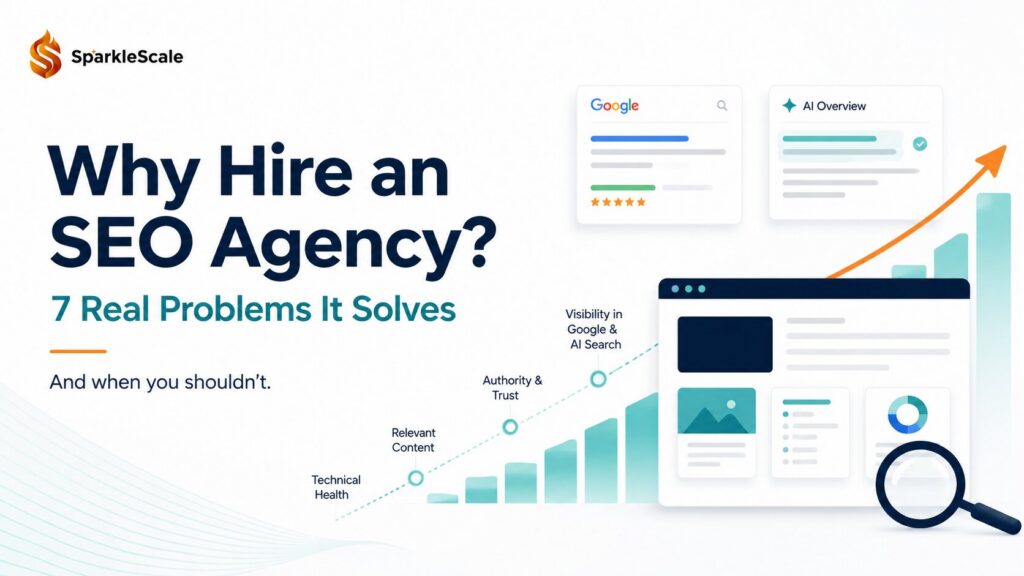
SEO is worth it when you have healthy margins, an offer that already converts, and a 6 – 12 month horizon. It’s not worth it if you need leads this month – run ads instead. An SEO agency makes sense when you have the budget but not the time or specialist skill in-house.
That’s the honest version, and I’m going to stand by it for the rest of this article including the part where I tell you when not to hire an agency.
I’ve spent 8 years doing SEO, first at Deloitte and then at a Toronto marketing firm, before founding SparkleScale. In that time I’ve watched the same pattern repeat: business owners don’t struggle to find articles telling them to hire an SEO agency. They struggle to find one that admits the answer is sometimes “not yet.” So instead of a sales pitch, this article works through the 7 actual business problems that make hiring an agency worth the money pulled from what owners really ask on Reddit and in Google, not from an agency’s wish list.
TLDR
- SEO agencies solve 7 specific problems: invisibility to buyers, stalled DIY efforts, rising ad costs, AI tools without strategy, unverifiable agency work, in-house cost math, and traffic plateaus.
- The typical agency retainer averages around $3,300 – 5,000/month (Ahrefs surveyed 439 SEO providers), but the US median is $4,000 – 8,000, and a full in-house team costs several times more.
- Skip the agency if you need leads within 30 days, haven’t proven your offer, or can’t commit to 6 – 12 months.
Is SEO worth it? The quick answer
Yes, if your business can wait for compounding results.
No, if you need revenue in the next 30 days.
SEO builds an asset. Every ranking you earn keeps producing traffic without a per-click fee, and the cost per lead falls over time as rankings compound. Paid ads are the opposite: instant, but the meter never stops running.
Most businesses eventually need both the question of sequence and budget.
SEO Decision Tree
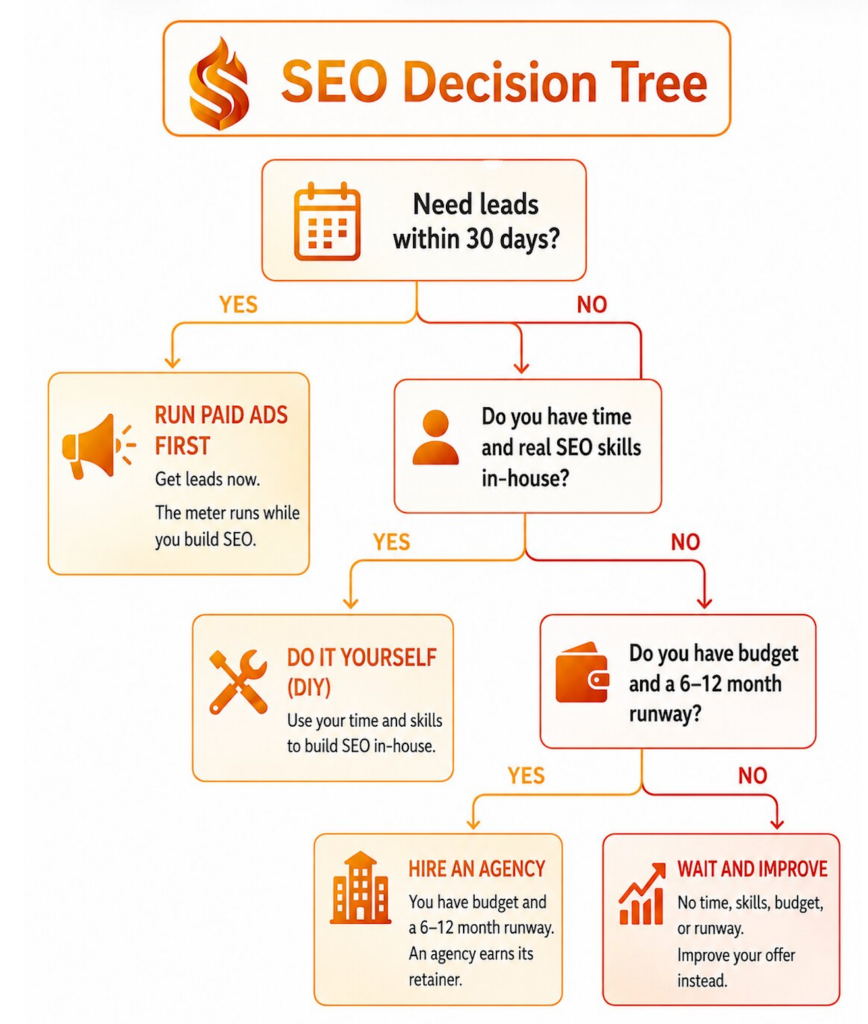
In words:
If you need leads this month, run paid ads first.
If you have time and real SEO skills in-house, do it yourself. If you have neither, but you do have budget and a 6 – 12 month runway, that’s when an agency earns its retainer. If none of those are true, wait and spend the money improving your offer instead.
Signs it’s time to hire an SEO agency
You don’t need an agency the day you launch.
You need one when you see these signals:
- Your traffic has been flat for 6 months or more despite publishing content
- Competitors consistently outrank you for the searches your buyers actually make
- Your cost per lead from Google Ads keeps climbing with nothing durable to show for it
- Nobody on your team has time for technical fixes, content, and links — the work that compounds
- You’re starting to lose visibility in AI answers (ChatGPT, Google AI Overviews) and don’t know why
Yana’s advice: Before you sign any retainer mine included, ask the agency to name the 3 biggest things holding your site back, specifically, based on your actual site. An agency that pitches a package before it’s looked under the hood is selling deliverables, not results. A 10-minute look at your site should already surface real issues; if all you get back is a generic checklist, keep looking.
The 7 problems an SEO agency actually solves
I’ve mapped each one to the way real owners phrase it mostly on Reddit, where nobody is being polite about it.
Problem 1: Is SEO worth it for a small business or is it a money pit?
Here’s what changed: the sale is now decided before anyone contacts you. SparkToro’s June 2026 study with Similarweb found that 68% of US Google searches now end without a single click. Buyers get their shortlist from the results page, AI Overviews, and map packs. If you’re not visible in that layer, you’re not losing clicks. You’re losing consideration entirely.
That’s the real answer to the money-pit question. SEO is a money pit when it’s done as random blog posts. It’s an asset when it’s aimed at the exact searches your buyers make in the week before they spend.
“You’re not losing clicks. You’re losing consideration.”
Problem 2: DIY SEO stalls out and you can’t tell why
DIY SEO almost always starts fine. You claim your Google Business Profile, write a few posts, maybe fix your titles. Then it stalls because the next layer is technical audits, a content cadence you can actually sustain, internal linking architecture, and earning links from other sites. That’s the part that compounds, and it’s the part that requires either specialist skill or 10+ hours a week you don’t have.
The honest split looks like this. Easy to DIY: claiming and updating your Business Profile, responding to reviews, basic on-page titles and descriptions. Needs sustained specialist time: technical fixes, keyword architecture, consistent publishing, link earning, and diagnosing why something isn’t working.
If you enjoy the craft and have the hours, DIY is legitimate. Most owners have neither they have a business to run.
Problem 3: Ad costs keep rising, and nothing is left behind
People on Reddit tell: “Google Ads are eating my margin is organic a way out?”
Every paid click is rented. The day you pause the campaign, the traffic is gone, and next quarter the same click costs more. Organic works in reverse: the cost is front-loaded, and the asset keeps producing.
Put real numbers on it. The Ahrefs pricing survey of 439 SEO providers found agencies average $3,209/month, with the US median at $2,000/month. Compare that to a competitive paid-search budget in your vertical for many of my clients in legal, renovation, and loans, $2,000/month in Google Ads disappears in days, not weeks. The retainer builds something; the ad spend rents something.
Problem 4: AI tools aren’t a strategy and AI search changed the rules
People on Reddit’re asking: “Can’t I just use ChatGPT to do my SEO now?” – the fastest-rising question of 2026
ChatGPT can draft a blog post. What it can’t do is decide what Google or ChatGPT itself will trust enough to cite. That’s determined by your site’s structure, your authority signals, your entity presence, and how your content is organized for extraction. AI-generated content published at scale without that layer is exactly what Google’s spam systems are built to catch.
And the stakes went up: the same SparkToro study found AI Overviews now appear on more than 20% of searches, and when one appears, click-through rates drop by nearly 60%. Winning in 2026 means being the source the AI answer cites which is a strategy discipline (we call it GEO, generative engine optimization), not a tool subscription. It’s also, frankly, why I built SparkleScale around both.
“The businesses winning right now aren’t the ones producing the most content with AI, they’re the ones AI trusts enough to cite. Those are 2 completely different games, and most owners don’t realize they’re playing the wrong one.”
— Yana Bilousova, Founder & CEO, SparkleScale
Problem 5: You can’t tell if an agency is actually doing anything
People on Reddit’re asking: “Are all SEO agencies scams? Everyone I talk to sounds shady.” – the highest-emotion recurring thread in the entire category
This fear is legitimate, and it’s the industry’s own fault. SEO reporting is easy to fake with vanity metrics – “we optimized 40 pages” tells you nothing about whether the phone rang. A good agency solves this problem by making its work verifiable: rankings tied to revenue keywords, changes you can see on your own site, reports you could hand to a skeptical accountant.
“If your agency can’t show you exactly what changed on your site last month and why, you’re not paying for SEO, you’re paying for a PDF. Every deliverable should be something you could verify yourself in 10 minutes.” – Yana Bilousova, Founder & CEO, SparkleScale
A good agency solves this problem by making its work verifiable: rankings tied to revenue keywords, changes you can see on your own site, reports you could hand to a skeptical accountant. I broke the exact checks down in a separate guide on how to tell if your SEO agency is actually doing anything.
Problem 6: A real in-house team costs more than a retainer
The math most owners haven’t run:
| Option | Typical monthly cost | What you actually get |
|---|---|---|
| Freelancer | ~$1,350/mo avg (Ahrefs) | 1 person, narrower scope – good for a defined slice like local SEO |
| Agency retainer | $2,000 – 3000 /mo US median; ~$4,209/mo avg | Strategist + writer + technical specialist coverage, no hiring overhead |
| In-house specialist | Salary + benefits + tools – typically well over $6,000/mo all-in | 1 person, no redundancy; tools cost extra |
| In-house team | Multiple salaries several times any retainer | Full control, full payroll |
One person in-house can’t be a strategist, writer, technical SEO, and link builder at once those are genuinely different skills. A retainer buys you slices of all four for less than one full salary. In-house starts to win when SEO is central enough to your revenue to justify a team, which for most SMBs is a later chapter, not chapter one.
The Ahrefs averages are honest, but they hide how much a retainer at a big agency pays for account managers, office overhead, and layers between you and the person doing the work. It’s part of why I priced SparkleScale‘s founding-client rates below that $3,209 average as a newer agency I don’t carry that overhead yet, and clients work directly with the strategist. Lower price here means fewer layers, not fewer corners cut. Whoever you hire, ask what share of the retainer goes to people actually touching your site.
Problem 7: Traffic plateaus need diagnosis, not more effort
People on Reddit’re asking: “My traffic has been flat for a year, what am I missing?”
The instinct when traffic flatlines is to publish more. But a plateau is almost never an effort problem, it’s a structural one. In audits, the usual suspects are keyword cannibalization (2 of your own pages competing for the same term), thin content that matches the keyword but not the intent, technical issues quietly blocking crawling, or a competitor who upgraded their content while yours aged.
You can’t see these from inside your own site you’re too close to it. An outside audit exists precisely to find the thing that’s been invisible to you for a year. It’s usually the fastest ROI in the entire engagement, because fixing a structural problem lifts everything you’ve already published.
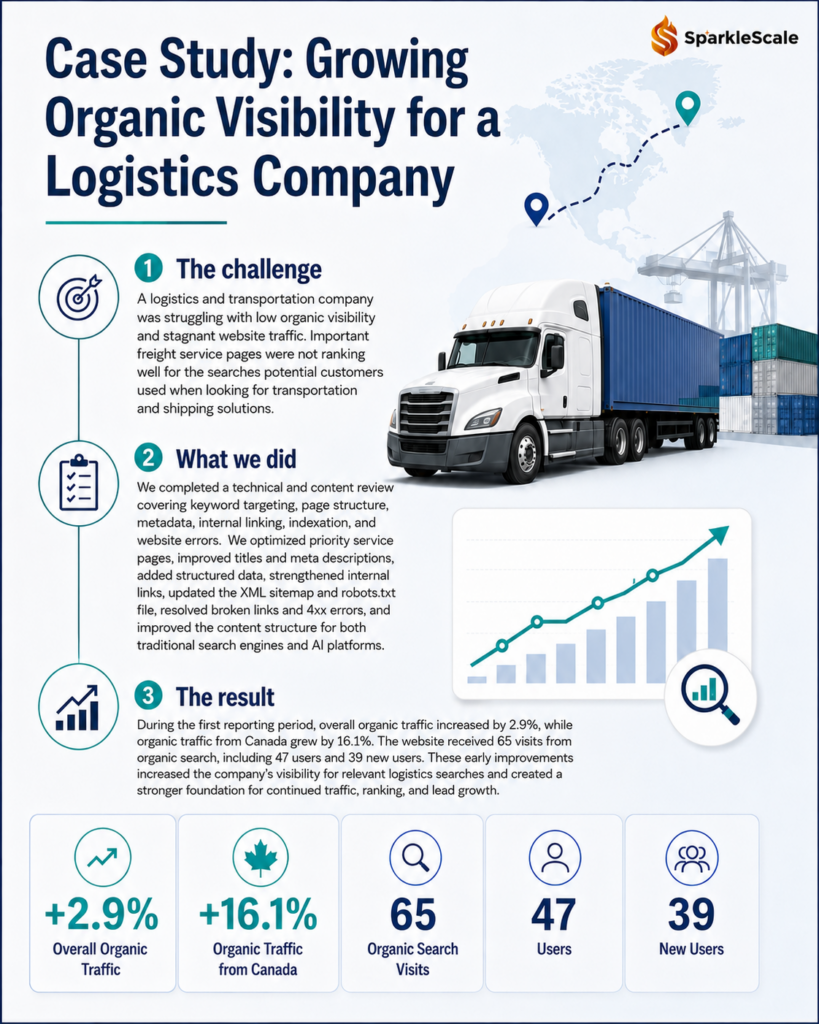
Case Study: Growing Organic Visibility for a Logistics Company
The challenge:
A logistics and transportation company was struggling with low organic visibility and stagnant website traffic. Important service pages were not ranking well for the searches potential customers used when looking for freight and transportation solutions.
What we did:
We reviewed the website’s technical SEO, keyword targeting, page structure, content, and internal linking. We then optimized priority service pages around commercially valuable searches, improved titles and descriptions, strengthened internal links, resolved technical issues, and created a clearer content structure for both search engines and AI platforms.
The result:
During the first reporting period, overall organic traffic increased by 2.9%, while organic traffic from Canada grew by 16.1%. The website received 65 visits from organic search, including 47 users and 39 new users. These early improvements increased the company’s visibility for relevant logistics searches and created a stronger foundation for continued traffic, ranking, and lead growth.
When you shouldn’t hire an SEO agency
Three situations where the honest answer is “not yet”:
You need leads within 30 days. SEO compounds on a months timeline, not weeks. Run paid ads or direct outreach for immediate revenue, and start SEO once cash flow can carry a 6 – 12 month investment.
Your offer isn’t proven. If people who find you don’t buy, more traffic just scales the problem. Fix conversion first SEO amplifies what’s already working.
The budget forces corner-cutting. If a realistic retainer would strain you, a $300/month package that quietly does nothing will strain you and waste six months. Wait, or start with a one-time audit and implement it yourself.
If you’re in one of these 3, I’d rather tell you now than invoice you for a year first. That’s the whole point of this article.
The honest bottom line
Hiring an SEO agency solves seven real problems: invisibility, stalled DIY, rented ad traffic, tools-without-strategy, unverifiable work, in-house cost math, and plateaus that need outside eyes. It solves none of them if you need leads this month or haven’t proven your offer.
If you’ve read this far and recognized your business in problems one through seven, the next step is simple: get an audit before you get a contract from us or anyone else. It’s the fastest way to see whether an agency can actually name what’s holding your site back.
SparkleScale runs on founding-client rates below the industry average, because there’s no account-manager layer between you and the strategist doing the work. Senior experience on every account, and I’ll tell you upfront if SEO isn’t worth it for you yet.
The questions I get before every contract
Is SEO worth it for a small business, or a money pit?
Yes, when the fundamentals are in place: an offer that converts, healthy margins, and patience for a 6 – 12 month horizon. With 68% of Google searches now ending without a click, visibility in search and AI answers decides who gets considered small businesses that aren’t visible lose the sale before it starts.
Do I need an SEO agency, or can I do it myself?
DIY works if you have real time (10+ hours weekly) and enjoy the craft basics like your Business Profile and on-page titles are learnable. Hire an agency when you need technical work, sustained content, and link earning done consistently while you run the business.
How long do I need to employ an SEO company for?
Plan on 6 – 12 months minimum to see compounding results, and judge the agency on leading indicators (rankings, impressions, technical fixes shipped) monthly along the way. Full breakdown here: how long SEO takes to work.
How much does an SEO agency cost? Ahrefs’ survey of 439 providers found agencies average $4,209/month, with the US median at $2,000 – $3,000/month. Freelancers average around $1,350/month. Price tracks scope: local campaigns cost less, national and competitive verticals cost more.
Should I hire an SEO agency or an in-house marketer?
For most SMBs, the agency wins on math: one in-house hire costs more per year than a mid-range retainer, and can’t cover strategy, content, technical, and links alone. In-house makes sense once SEO is central enough to your revenue to justify a full team.